
Childhood Myopia Management in Orland Park
Helping Slow Nearsightedness in Growing Eyes
Myopia, or nearsightedness, is becoming increasingly common in children. It often progresses as the eye grows too long from front to back, causing distance vision to become blurry and prescriptions to worsen over time.
Today’s myopia management treatments can do more than simply correct blurry vision. They are designed to help slow progression, monitor eye growth, and support your child’s long-term eye health.
At Vision Source – Orland Park, our doctors provide personalized myopia management using advanced testing and treatment options such as Ortho-K nighttime retainers, MiSight® 1 day contact lenses, Essilor® Stellest® lenses, and low-dose atropine eye drops when appropriate.
Schedule a Myopia Management Evaluation
Why Myopia Management Matters
Traditional glasses and standard contact lenses help children see clearly, but they do not necessarily slow the eye growth that causes myopia to progress.
Myopia management focuses on more than correcting blurry distance vision. The goal is to help slow progression and monitor the underlying eye growth behind prescription changes.
At Vision Source – Orland Park, we evaluate your child’s prescription, visual habits, eye health, and axial length measurements to help determine the most appropriate treatment plan.
Is Your Child at Risk for Myopia?
A child’s risk of developing myopia can be influenced by family history, prescription changes, near work, screen habits, and time spent outdoors.
- One or both parents are nearsighted
- Prescription is changing year after year
- Frequent near work or extended screen time
- Limited time spent outdoors
- Squinting or trouble seeing the board at school
Helpful educational tools:
Brian Holden Vision Institute Myopia Calculator
Myopia Care Risk Calculator
These calculators are helpful educational tools, but they do not replace a comprehensive eye exam or professional myopia management evaluation.
Measuring Eye Growth with Axial Length
Myopia often progresses as a child’s eye grows too long from front to back. This measurement is called axial length.
At Vision Source – Orland Park, we use the OCULUS Myopia Master®, a specialized instrument called a biometer, to measure axial length and monitor how your child’s eyes are growing over time.
This advanced technology helps our doctors:
- Track eye growth over time
- Create personalized growth charts
- Detect signs of progression earlier
- Evaluate how well treatment is working
- Adjust your child’s myopia management plan when needed
By tracking axial length, we can look beyond the prescription and better understand the eye growth behind your child’s myopia.
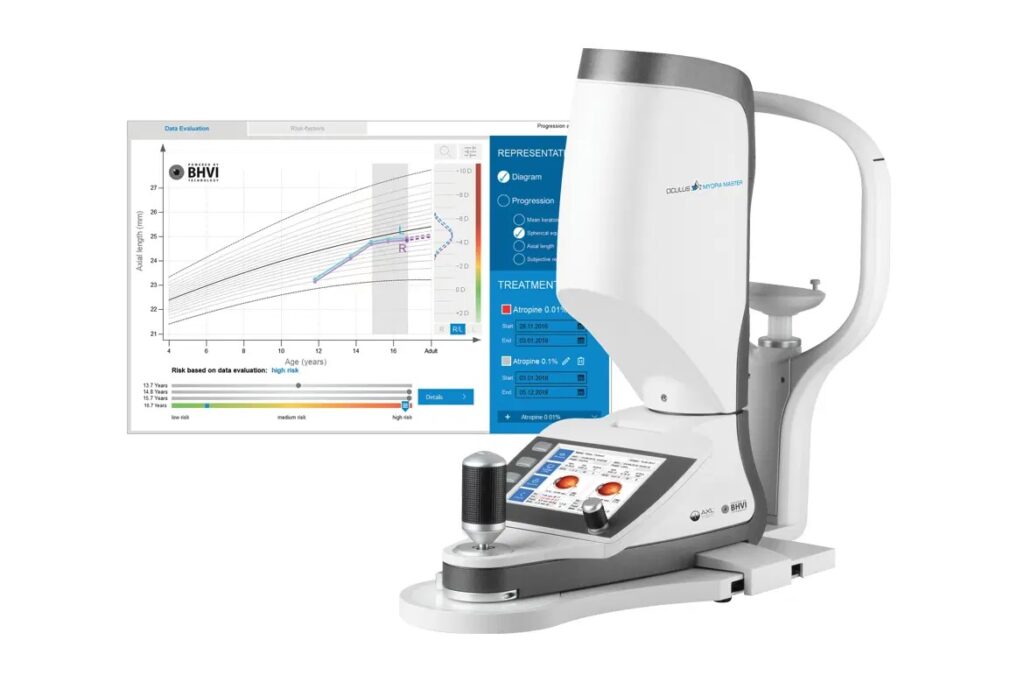
The OCULUS Myopia Master® allows our doctors to measure axial length and track eye growth as part of your child’s myopia management plan.
Myopia Management Treatment Options
There is no single myopia management treatment that is best for every child. The right option depends on your child’s age, prescription, eye shape, axial length, maturity, lifestyle, hygiene habits, and ability to follow the recommended treatment plan.
After a complete evaluation, our doctors may recommend one treatment option or a combination approach when appropriate.
MiSight® 1 Day
Soft, daily disposable contact lenses worn during the day to provide clear vision while helping slow childhood myopia progression.
Ortho-K Nighttime Retainers
Custom-designed lenses worn while sleeping. Many children can see clearly during the day without glasses or daytime contact lenses.
Essilor® Stellest® Lenses
Specialized eyeglass lenses designed to slow myopia progression while providing clear, comfortable vision.
Low-Dose Atropine Eye Drops
A medication-based option that may be recommended for some children, sometimes as part of a combination treatment plan.
MiSight® 1 Day Contact Lenses
MiSight® 1 day contact lenses are soft, daily disposable lenses worn during the day to provide clear vision while also helping slow the progression of childhood myopia.
Unlike regular soft contact lenses, MiSight® lenses use a special dual-focus design. This design corrects your child’s vision while helping reduce the stimulus for excessive eye growth.
Because MiSight® lenses are daily disposable, children wear a fresh pair each day and throw them away at night. This makes them a convenient option for many families and active children.
Our doctors can determine whether MiSight® 1 day lenses are appropriate based on your child’s age, prescription, eye health, and readiness for contact lens wear.
Ask if MiSight® 1 Day Is Right for Your Child
Ortho-K Nighttime Retainers
Ortho-K lenses are custom-designed retainers worn while sleeping. They gently reshape the front surface of the eye overnight, allowing many children to see clearly during the day without glasses or daytime contact lenses.
Ortho-K may be especially helpful for active children, athletes, or children who prefer daytime freedom from glasses and contacts.
Careful lens handling, cleaning, and follow-up care are important. Our doctors will determine whether your child’s prescription, corneal shape, eye health, and maturity make Ortho-K an appropriate option.
Learn More About Ortho-K for Myopia Management
Essilor® Stellest® Lenses
Essilor® Stellest® lenses are specialized eyeglass lenses designed to correct vision while also helping slow myopia progression in children.
They look like regular glasses but use advanced optical technology to help manage how light focuses in the eye. Stellest® lenses may be a good option for younger children, children who are not ready for contact lenses, or families who prefer a glasses-based treatment option.
Our doctors can determine whether Stellest® lenses are appropriate based on your child’s age, prescription, visual needs, and overall myopia management plan.
Low-Dose Atropine Eye Drops
Low-dose atropine eye drops may be considered for some children with progressing myopia, especially when contact lenses are not the best fit or when our doctors recommend a medication-based or combination approach.
Atropine treatment is prescribed only after a full evaluation and discussion of your child’s specific needs. If recommended, our doctors will explain how the drops are used, what follow-up care is needed, and how treatment progress will be monitored.
Which Myopia Management Option Is Right for Your Child?
The best treatment depends on many factors, including your child’s prescription, age, eye shape, axial length, eye sensitivity, lifestyle, sports, hygiene habits, and ability to follow treatment instructions.
Our doctors will help you compare the available options and recommend a plan that fits your child’s needs.
| Option | How It Is Used | May Be a Good Fit For |
|---|---|---|
| MiSight® 1 Day | Soft daily disposable lenses worn during the day | Children ready for daytime contact lens wear |
| Ortho-K | Custom retainers worn overnight while sleeping | Active children who want daytime freedom from glasses or contacts |
| Stellest® Lenses | Specialized eyeglass lenses worn during the day | Children who prefer glasses or are not ready for contact lenses |
| Low-Dose Atropine | Eye drops used as prescribed | Children who may benefit from medication-based or combination therapy |
Outdoor Time and Healthy Visual Habits
Myopia management treatment works best as part of a broader plan for healthy visual habits. Outdoor time, regular breaks from near work, and good visual ergonomics may help support your child’s overall eye development.
Helpful habits include:
- Spending regular time outdoors
- Taking breaks from prolonged reading, homework, or screen use
- Holding books and devices at a comfortable distance
- Using good lighting for near work
- Wearing UV protection outdoors
- Keeping regular eye exam and myopia management follow-up visits
Outdoor time is not a replacement for myopia treatment, but it remains an important part of a healthy visual routine.

Frequently Asked Questions About Myopia Management
Can myopia be reversed?
Myopia usually cannot be reversed, but progression can often be slowed. The goal of myopia management is to reduce the rate of worsening and monitor the eye growth that contributes to progression.
Are regular glasses enough?
Regular glasses help your child see clearly, but they may not slow myopia progression. Myopia management treatments are designed to address progression, not just blurry vision.
Which myopia treatment works best?
There is no single best treatment for every child. MiSight®, Ortho-K, Stellest® lenses, and low-dose atropine may all be considered depending on your child’s age, prescription, eye shape, maturity, lifestyle, and treatment goals.
How often will my child need follow-up visits?
Children in myopia management need regular follow-up visits so our doctors can monitor prescription changes, eye health, axial length growth, and treatment effectiveness.
Take a Proactive Approach to Your Child’s Nearsightedness
If your child’s prescription is changing, now is the time to ask about myopia management. Our doctors can evaluate your child’s risk, measure eye growth, and recommend a personalized treatment plan.
At Vision Source – Orland Park, we are here to help your child see clearly today while taking steps to protect their vision for the future.